


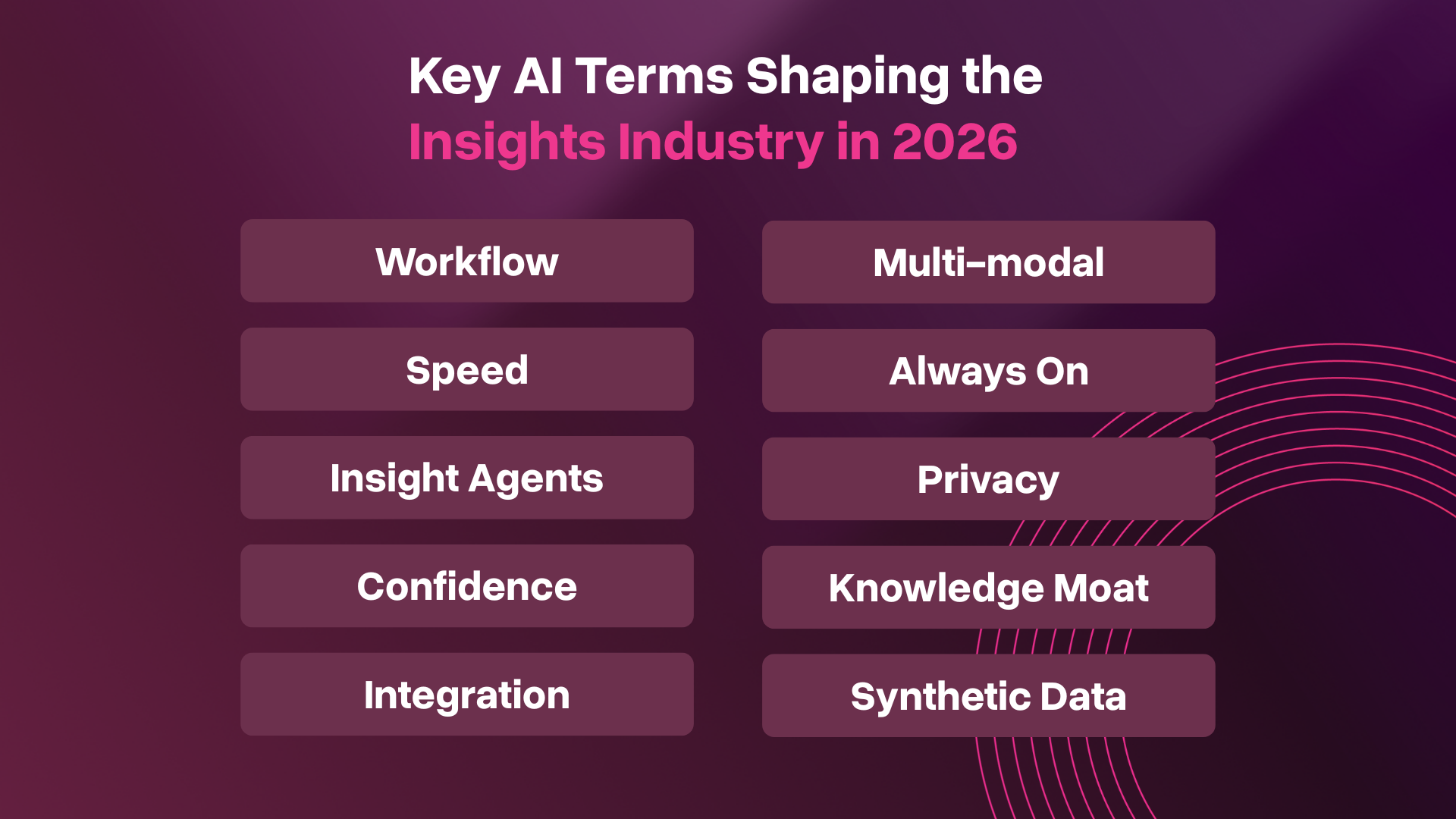
2026 is shaping up to be a make-or-break year for the insights industry. To understand what really matters, I spoke with my colleagues at Platform One, who consulted their clients to identify the key terms shaping our ecosystem.
The theme connecting them all is clear: the rise of AI and its implications.
1. Workflow
Workflow is how people, teams, and organisations get stuff done. It's the sequence of steps, handoffs, and decisions that turn a brief into a deliverable. For AI to be genuinely helpful, it has to fit within and improve these existing workflows rather than sit alongside them as a separate, disconnected tool.
AI implementations often fail because they're bolted on without understanding how work actually flows. The insights teams that will thrive in 2026 are those that start with workflow and then identify where AI can remove friction, accelerate progress, or enhance quality.
Action Point: Map how work actually gets done in your organisation right now. Identify the critical steps, the logjams, and the places where people most want help. These are your starting points for meaningful AI integration.
2. Speed
We talk about better and cheaper, but the key driver in 2026 will be speed. This continues a trend we saw as research moved from in-person to CATI and then online. If insights can be delivered at the speed of business, they will be used more widely. They will be used earlier and iteratively, rather than slowly built up into expensive, one-off exercises. Most clients are looking to move from days to hours as part of this change.
Action Point: Prioritise speed as a primary objective, not a nice-to-have. If an AI solution only makes things 10% quicker, consider whether a fundamentally different approach might deliver the step-change you actually need.
3. Insight Agents
Agents will be the defining AI theme of 2026. But what does this mean for insights professionals? An agent is an AI system that can autonomously execute multi-step tasks, make decisions, and take actions on your behalf. Unlike a chatbot that simply responds to prompts, an agent can plan a sequence of steps, use tools, and work through complex processes with minimal human oversight.
Insight agents are not primarily about speed. They represent a shift in who does the work, moving routine, repeatable research tasks from people to autonomous systems.
For the insights industry, this translates to insight agents: AI systems that can automate end-to-end research workflows.
Action Point: Audit your current workflows and identify tasks that are repeated, rule-based, and time-consuming. These are your opportunities to build or deploy insight agents that improve efficiency, consistency, and scalability.
4. Confidence
As AI becomes more embedded in the insights process, the critical question shifts from Can we trust this? to How confident should we be in acting on it? Confidence is not binary. It exists on a spectrum and must be deliberately earned, communicated, and understood.
Confidence comes from several factors working together. It requires guardrails to prevent poorly framed questions from generating false answers and to ensure stakeholders understand how much confidence to place in any finding. It requires knowing that the underlying data is reliable and fit for purpose, because AI can make the traditional ‘garbage in, garbage out’ problem harder to spot, because the garbage out can be very plausible. And it requires human judgment to evaluate whether advice from an AI system can be acted upon.
Action Point: For any AI-driven insight, ask three questions: What guardrails are in place? Where did the data come from? And who is applying human judgment before this reaches a decision-maker?
5. Integration
Perhaps the biggest weakness of AI so far has been its lack of integration. Clever but isolated technologies are not particularly useful.
Integration means connecting AI capabilities to the places where work actually happens: your data platforms, project management tools, reporting systems, and client deliverables. It means creating AI that fits seamlessly into existing workflows rather than demanding new ones.
Action Point: Before adopting any new AI tool, ask: how does this connect to what we already use? Prioritise solutions that integrate with your existing systems and workflows and be wary of standalone tools that create new silos.
6. Multi-modal
So far, most of the AI revolution has been text-based. That's changing. Multi-modal means AI that can work across different formats such as text, images, audio, and video, both as inputs and outputs.
For insights professionals, this opens up two opportunities. First, richer analysis: learning from images, audio, and video rather than just text and numbers. Second, richer delivery: creating outputs that go beyond written reports to include video summaries, audio briefings, and stronger visuals such as infographics.
Action Point: Look at the data you're currently not analysing because it's too time-consuming, such as open-ended video responses, social media images, and call recordings. These are now accessible. Re-think your deliverables, leveraging multimedia and personalising them to the requirements of different audiences.
7. Always On
The traditional model of insights is project-based. Commission a study, collect data, deliver a report, move on. Always on represents a fundamental shift away from this approach.
For data collection, always on means continuous listening and observation rather than discrete exercises. It means building up an ongoing understanding rather than taking periodic snapshots.
For delivery, always on means insights that are consistently updated and accessible whenever stakeholders need them. It's a shift away from static reports toward systems that let users tap into current, relevant guidance at any time using AI.
Action Point: Identify one area where you currently run repeated, similar projects. Could this become an always-on programme that delivers continuous insight rather than periodic updates? Look at your deliverables. Where could you implement Always On?
8. Privacy
We have become accustomed to what privacy means online. AI raises a whole new set of issues. Can data be de-anonymised by combining it with other sources? What are the implications of findings generated by AI? How do we protect users, clients, and participants in this new environment?
There will be privacy failings in 2026, and these will shape what happens in our industry. The organisations that get ahead of this will be those that think through the implications now, rather than reacting after something goes wrong.
Action Point: Review your current data practices through an AI lens. Ask whether data that was safe in traditional research could become a risk when processed by AI, and ensure you have clear policies in place before issues arise.
9. Knowledge Moat
As AI tools become widely available, using AI will not offer a competitive advantage. Everyone will have access to the same powerful capabilities. The differentiator will be what you feed into those tools and how you use them. The term "moat" refers to a competitive advantage that is difficult for others to cross.
Organisations that have accumulated proprietary information over time, such as years of studies, sector expertise, methodological know-how, and client-specific understanding, have a genuine knowledge moat. This accumulated wisdom becomes more valuable, not less, in an AI-enabled world. It's the fuel that makes generic AI tools deliver specific, differentiated value.
Action Point: Audit your knowledge assets. What studies, data, frameworks, and institutional knowledge have you built up over the years? Consider how to organise and structure this information so it can be used effectively with AI tools to create outputs your competitors cannot replicate.
10. Synthetic Data
Synthetic data is already here. Most leading panel companies offer it and many major clients use it regularly (and many reject it). Whether you use synthetic data or not, you need a position on it.
At present, the validity and scope of synthetic data remain open questions. When does it work well? When does it fall short? What safeguards are needed? These questions do not yet have definitive answers, and the technology is evolving rapidly.
For insights professionals, 2026 is the year to get informed and get practical. This means understanding what synthetic data is, monitoring its development, and experimenting to learn where it adds value and where caution is warranted.
Action Point: If you are not already using synthetic data, start exploring it now. Run experiments to understand its strengths and limitations. Develop a clear point of view to advise stakeholders on when synthetic data is appropriate and when traditional methods remain essential.
What This Means for the Insights Industry
AI is no longer an experiment for the insights industry. In 2026, it becomes infrastructure.
At Platform One, we are actively evolving to reflect this shift. We are integrating AI into workflows, combining with existing platforms, and developing approaches that prioritise speed while maintaining confidence, governance, and privacy.
How will you embed AI infrastructure to your everyday insight practices?